
본문으로 건너뛰기
Engaged to the Muse cover image

Engaged to the Muse

In Mexico City, 2025, a disciplined scholarship student reluctantly signs a 'pretend engagement' contract with a mysterious transfer princess, whose secret magical heritage threatens to spiral out of control as their staged romance becomes dangerously real; switching between the perspectives of their skeptical friends, disapproving families, and rival musicians, the students struggle to harmonize their desires during a citywide musical competition, where winning—against the glittering neon backdrop—could secure freedom, love, and the strength to define their own destinies.

Weekly ranking

rank icon image
#2 inGenre
rank icon image
#3 inGenre
rank icon image
#4 inGenre
Scroll

Plot Synopsis

Lucía Marlowe had always believed that discipline could bend the world to her will. In the electric heart of Mexico City, 2025, she lives by rigid routine and hard-won skill, her battered violin case an anchor in a sea of privilege and spectacle at the city’s most prestigious music academy. Every morning, Lucía wakes before dawn, practicing scales until her fingers ache—each note a small act of defiance against the soft sneers of classmates with last names older than the city’s cathedrals. The upcoming citywide musical competition is her singular focus: to win is to secure a future for her family, to silence the whispers, to finally belong. Her mother reminds her, nightly, of the stakes. Her friends either envy her drive or misunderstand it entirely. But Lucía’s resolve is shaken when Anaís Ortega de la Vega, the academy’s dazzling new transfer, interrupts rehearsal with an offer no sane outsider could refuse: a ‘pretend engagement’ contract, complete with a stipend and enough leverage to guarantee Lucía a spot in the competition’s main stage.

Anaís is everything Lucía distrusts—aristocratic, immaculate, and mysterious, her every move orchestrated for maximum effect. But beneath the icy perfection, Anaís is trapped by her own legacy: her family’s name is both shield and shackle, and the city’s neon-lit stages are haunted by rumors of magic in her bloodline—a heritage she must hide at all costs. The engagement is a gambit, a way to deflect pressure from rival musicians and her own controlling relatives, who are desperate to secure her place at the top. For Lucía, the contract is a humiliating compromise, but the possibility of freedom for her family is too potent to resist. Their staged romance becomes the talk of the academy, feeding gossip blogs and fueling the rivalry with Diego Yáñez Sato—Lucía’s fiercely independent friend and the city’s prodigy street percussionist, whose loyalty to the underdog clashes with Anaís’s calculated world.

From the start, the arrangement is chaos: Lucía’s blunt honesty grates against Anaís’s rehearsed charm, and their rehearsals erupt into arguments over tempo, interpretation, and the very soul of music. Diego, caught between loyalty to Lucía and suspicion of Anaís, attempts to mediate, only to be drawn into the competition himself when his crew of street musicians is threatened by new academy regulations. As the city’s musical elite and underground talent collide, alliances shift—Anaís uses her connections to protect Diego’s crew, but not without demanding creative control, while Lucía is forced to confront the limits of her own independence. Their choices ripple outward: Lucía’s willingness to compromise for her family alienates her closest friends, Anaís’s calculated risks attract the scrutiny of her family’s rivals, and Diego’s refusal to play by the rules puts everyone’s future in jeopardy.

But beneath the staged romance, something unpredictable begins to grow. Lucía, who trusts no one, finds herself haunted by Anaís’s vulnerability in unguarded moments: the way her hands tremble before a performance, the quiet rebellion in her late-night laughter. Anaís, for all her strategy, is drawn to Lucía’s raw honesty—a kind of courage she’s never allowed herself. The city’s neon lights become their clandestine world, where truth slips through in music neither of them can control. Yet Anaís’s secret—her magical heritage, inherited from a line of muses who can channel emotion into music with dangerous consequences—begins to unravel. During a high-stakes rehearsal, Anaís loses control, her violin conjuring a storm of sound that fractures glass and leaves the auditorium in stunned silence. Word spreads, and suddenly the ‘engagement’ is more than a game: Lucía becomes Anaís’s shield, her only alibi, while Diego must decide whether to expose the truth or help them hide it.

As the citywide competition approaches, the stakes become existential. Rival musicians—some hungry for fame, others for revenge—begin to sabotage their performances, leveraging both gossip and Anaís’s secret. Disapproving families close ranks, threatening Lucía’s scholarship and Diego’s livelihood. The trio’s fragile alliance fractures under pressure: Lucía accuses Anaís of manipulation, Anaís lashes out at Lucía’s distrust, and Diego, caught in the crossfire, risks everything by leaking a demo track that fuses their styles—street, classical, and something wild and magical—onto the city’s airwaves. The track goes viral, making them instant legends but also painting a target on their backs. In the fallout, Lucía’s family is threatened with eviction, Anaís is nearly disowned, and Diego’s crew is banned from academy venues. Each must decide: fight for themselves, or risk everything for each other.

The night of the competition arrives beneath a sky pulsing
Model Used
GPT-4.1
text
Stable Diffusion
image

Story Details

Keytalk Prompts Used
See all Keytalks
no chosen prompts
no chosen prompts
no chosen prompts
no chosen prompts
no chosen prompts
no chosen prompts
Model Used
GPT-4.1
text
Stable Diffusion
image

Character

Protagonist Character

Lucía Marlowe

GenderFemale
OccupationViolinist & Scholarship Student

Profile

Lucía Marlowe stands at 5'7" with a lean, almost wiry build that betrays years of disciplined practice and the constant tension of striving to belong. With expressive, deep-set brown eyes framed by thick, arched brows and a cascade of wavy, midnight-black hair usually pulled into a messy bun or loose braid, she projects a certain restless intensity. Her mixed heritage—Mexican on her mother’s side, British on her absent father’s—shows in her sharp cheekbones, olive-toned skin, and a delicate Roman nose, giving her an edge of both familiarity and foreignness in Mexico City’s bustling music academy. Lucía’s clothing is strictly utilitarian: thrifted blazers, faded jeans, and scuffed combat boots, punctuated by a battered leather violin case slung over her shoulder and a silver Saint Jude medallion she nervously thumbs before auditions. Precise, reserved, and often blunt, Lucía’s speech carries the clipped rhythms of Chilango Spanish interspersed with crisp, British-accented English—a habit from years of code-switching at home and school, and a source of endless teasing from her peers. As a scholarship student, she is both fiercely independent and painfully aware of her outsider status among the city’s privileged elite, driving her to overcompensate with relentless work ethic and an unyielding moral compass. Lucía’s natural skepticism and dry wit often mask a deep-seated longing for stability and acceptance, and she’s quick to challenge authority or tradition when it threatens her hard-won autonomy. Her core motivation is simple but unshakeable: music is her lifeline, and winning the citywide competition represents not just personal validation but a tangible escape for her working-class family. While she’s a technical prodigy—able to sight-read impossibly complex pieces and improvise haunting melodies—her greatest challenge lies in letting herself trust others, especially when thrown into the orbit of a dazzling, enigmatic transfer princess. Unconsciously, Lucía hums under her breath when anxious, and scribbles musical notations on any available surface. Her relationships are few but fiercely guarded, and she has a complicated loyalty to the friends who both envy and misunderstand her. As the story begins, Lucía is caught between the rigid lines of her own ambition and the dizzying, unpredictable harmony demanded by the city’s neon-lit stage—a tension that will force her to confront both the limits and the possibilities of her carefully orchestrated world.

Antagonist Character

Anaís Ortega de la Vega

GenderFemale
OccupationHeir to a Prestigious Conservatory & Pop Idol Violinist

Profile

Anaís Ortega de la Vega stands at an elegant 5'8" with a dancer’s lithe build, every movement a study in cultivated poise and precision. The daughter of a storied Spanish-Mexican dynasty, Anaís is the luminous face of Mexico City’s most prestigious conservatory—her striking, angular features and deep-set hazel eyes always framed by a curtain of glossy black hair swept into a severe, immaculate chignon. Her fashion is a calculated fusion of haute couture and stage-ready drama: custom-tailored blazers with jewel-tone silk blouses, dazzling gemstone earrings, and signature high-heeled boots that click like a metronome through marble hallways. Raised in the rarefied world of patronage and performance, Anaís is both pop idol and classical prodigy, a violinist who commands adoring crowds with a single, imperious bow stroke, yet whose ambition is coldly pragmatic. Her speech, tinged with the clipped cadences of Castilian Spanish beneath flawless English, is measured, formal, and icily precise—her words chosen like notes in a solo, always tuned for maximum effect. Anaís is driven by the iron logic of legacy, shaped by a childhood spent backstage, negotiating rival families and sponsors, mastering both music and social maneuvering. She is ruthlessly disciplined—never seen with a hair out of place or a note off-pitch—but her perfectionism feeds an unrelenting anxiety: the fear that even a single misstep could topple her from her gilded pedestal. Her private world is one of regimens and rehearsals, but she hides a surprising penchant for subversive humor and a taste for late-night street food, indulged only when she believes no one is watching. Anaís is fiercely protective of her younger brother, leveraging her status to shield him from the same pressures that shaped her, but she keeps most at arm’s length, wary of betrayal or distraction. As the city’s musical competition looms, Anaís’s relentless drive, strategic brilliance, and air of untouchable glamour make her a formidable rival—one whose every action is calculated to secure not just victory, but the enduring supremacy of her family’s name, even if it means manipulating the very rules of the game.
Sidekick Character

Diego Yáñez Sato

GenderMale
OccupationStreet Percussionist & Sound Engineer

Profile

Diego Yáñez Sato stands at a wiry 5'10", his lean frame a testament to years spent lugging battered drum cases through Mexico City’s labyrinthine streets and metro tunnels. Of mixed Mexican and Japanese heritage, his skin is a warm olive shade, and his sharp, angular features are softened by perpetually tousled black hair streaked with platinum at the tips—a rebellious nod to both ancestry and the city’s neon pulse. Diego’s deep-set, almond-shaped eyes, the color of over-steeped tea, rarely betray his thoughts, but his lopsided grin is legendary among fellow musicians. He dresses in thrifted graphic tees, patched cargo pants, and battered sneakers, with a custom-built analog sampler slung across his chest like a talisman. Raised in a bustling, multigenerational household in the working-class neighborhood of Tepito, Diego learned early to mediate chaos with rhythm; the city’s cacophony is his creative wellspring. As a street percussionist and freelance sound engineer, he juggles late-night gigs with daytime studio work, fiercely protective of his creative independence and deeply suspicious of institutions—traits sharpened by watching friends get chewed up by the music industry’s flashy promises. Diego’s approach is intuitive, bordering on improvisational genius, and he sees music as a living conversation rather than a competition—a philosophy that often puts him at odds with the rigid perfectionism of both Lucía’s discipline and Anaís’s pop idol polish. Pragmatic and unsentimental on the surface, he’s the kind who’ll quietly fix a broken amp or mediate a band argument before disappearing into the night. He’s driven by a fierce loyalty to his chosen family—the motley crew of street musicians he mentors—and dreams of establishing an open-access studio where music is a right, not a privilege. Though his skepticism can read as aloofness, and his sarcasm sometimes stings, Diego’s empathy is bone-deep; he’s drawn to lost causes and underdogs, compelled to bridge worlds others won’t touch. His speech, peppered with Chilango slang and snatches of Kansai dialect, is fast, vivid, and often ironic, masking a tendency to overthink and a quiet fear of letting people down. Diego’s technical savvy and outsider’s perspective make him an indispensable foil to both Lucía’s earnestness and Anaís’s entitlement, grounding the story’s emotional stakes in the city’s restless rhythm and ensuring that, no matter how magical things get, the music always has a pulse that’s real.
Model Used
GPT-4.1
text
Stable Diffusion
image

World

Location/Time, Era:
Mexico City, 2025: a metropolis at the threshold of magic and modernity, where colonial cathedrals cast shadows over glassy skyscrapers, and every plaza pulses with competing rhythms—cumbia, synth-pop, mariachi, and the secret language of violins. The city’s sprawling music academy, perched on the edge of the historic center, is both a fortress and a stage, its labyrinthine corridors echoing with the footfalls of prodigies and the hush of ancient secrets. Nightfall brings a neon transformation: billboards flicker with concert footage, street vendors hawk tamales beside holographic buskers, and rooftop gardens host midnight battles of sound. Here, tradition and rebellion collide in every alley, and the boundaries between performance, protest, and spellwork are blurred by the city’s restless energy. The air is thick with ambition, longing, and the electric possibility that the right song could change everything.

Key rules of the world and their impact on the story and beyond:
Music is power—literally. A clandestine lineage of “muses” can channel emotion into reality-altering magic through performance, but strict cultural taboos and institutional codes forbid overt displays, enforced by a shadowy board known as the Patronato. The citywide competition is governed by merciless regulations: scholarship students must maintain flawless reputations, and any whiff of scandal—magical or otherwise—means instant expulsion. Social mobility is a blood sport; contracts, like Anaís’s “pretend engagement,” are legal tools for maneuvering through the academy’s labyrinthine bureaucracy and for shielding secrets from both rivals and one’s own family. The ever-present threat of exposure—be it a magical outburst or a viral scandal—keeps every character teetering between survival and transcendence, forcing alliances and betrayals that ripple far beyond the academy walls.

Visual depiction of the world and its unique features:
By day, the academy’s architecture is a surreal fusion of colonial arches, brutalist concrete, and stained glass refracting sunlight into rainbows across the practice rooms. Students scuttle between rehearsal spaces, their cases plastered with stickers and charms—wards against failure, envy, or worse. At dusk, the city ignites: magenta and indigo flood the sky, every surface reflects neon signage, and rooftop gardens bloom with illicit parties and whispered challenges. Street performers gather at the Zócalo, their acts blending traditional folk rituals with glitching light shows; in forgotten subway tunnels, underground bands rehearse amidst graffiti that glows with faint, otherworldly patterns. In this world, beauty is always edged with danger, and even the simplest melody might summon storms—literal or figurative.

Notable technology, philosophy, or cultural elements influencing the world and narrative:
Augmented reality overlays are ubiquitous, turning every smartphone into a portal for live-streaming performances, tracking gossip, or decoding magical “signatures” hidden in music. The academy’s elite wield sponsorships like weapons, their families’ power measured in both pesos and followers, while working-class students like Lucía barter in favors and reputation. The prevailing philosophy among the privileged is “legacy above all,” but the city’s undercurrent is shaped by a DIY ethos—music as resistance, community, and survival. Rumors of “cursed” tracks, bootleg magical recordings, and forbidden jam sessions circulate through encrypted group chats. Ultimately, the collision of magic, technology, and social stratification creates a world where every note has consequence, and every performance might unmake or remake reality itself.
representative image
location 1 image

Location 1

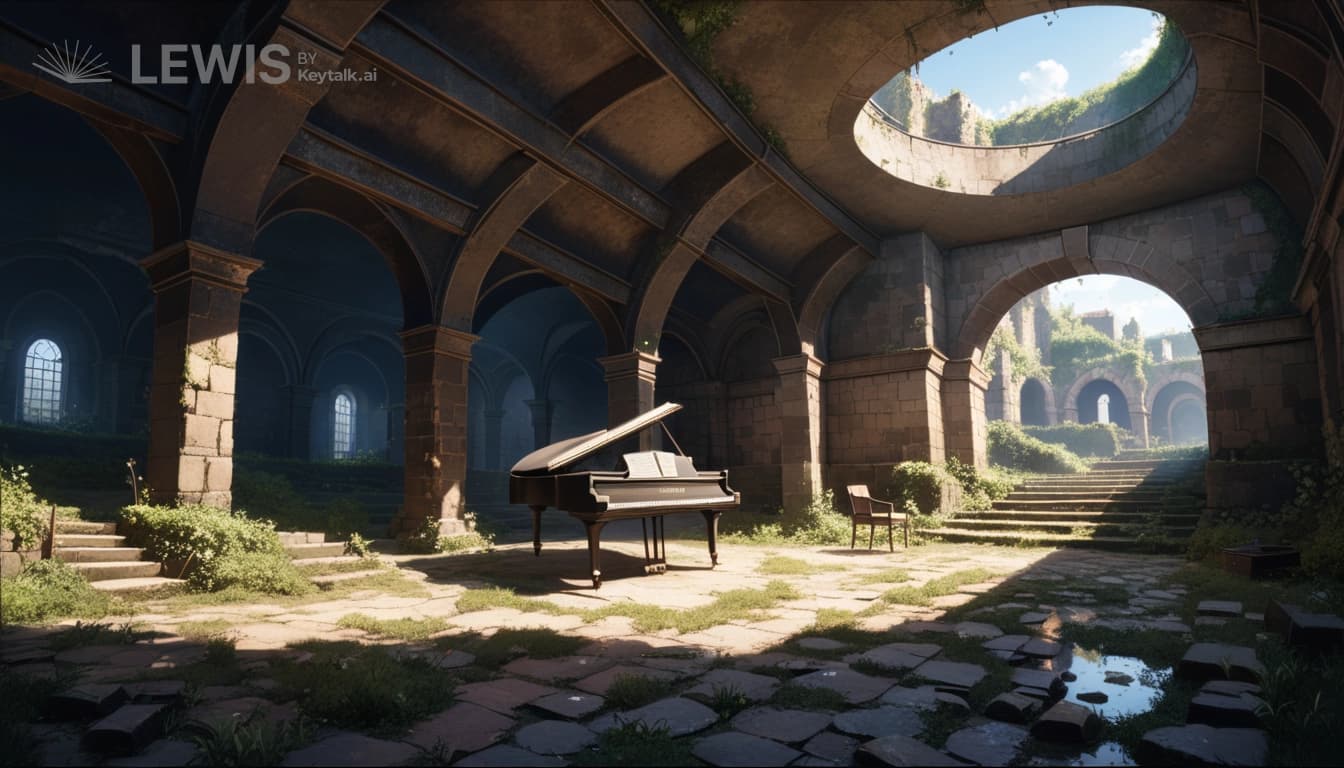
Title: The Vault of Silenced Notes
Description: Buried beneath the academy’s marble-and-glass façade, the Vault is a forgotten rehearsal hall sealed off after a scandal years ago—its stone walls scored with centuries of desperate practice, the air thick with dust and the scent of resin and sweat. Fluorescent lights flicker overhead, illuminating battered music stands, a cracked grand piano, and faded graffiti—musicians’ secrets scrawled in every language of the city. This is where Lucía and Anaís first test the boundaries of their arrangement: their music echoing off walls that remember every failure and forbidden triumph, daring them to make a sound the world cannot ignore.
location 2 image

Location 2

Title : Casa Jaguar—The Rooftop Sanctuary of Exiled Musicians
Description : High above the choking gridlock of Mexico City, Casa Jaguar sprawls across a forgotten rooftop, tangled in wild bougainvillea and the glow of battered fairy lights. Here, on cracked tiles still warm from the day’s sun, exiled musicians gather in secret—a patchwork of battered amps, mismatched plastic chairs, and the faint scent of mezcal and sweat, all pulsing to the rhythm of forbidden improvisation. It’s where Lucía and Diego, desperate and electric, first fuse their raw, defiant sounds beneath a sky thrumming with danger and possibility—watched by Anaís, her carefully constructed world trembling on the edge of something real.
location 3 image

Location 3

Title : The Mercado de las Almas Errantes (Market of Wandering Souls)

Description : At midnight, the Mercado unfurls beneath tangled wires and flickering neon, a labyrinth of shadowed stalls where forbidden instruments change hands and music is currency for secrets. Incense coils through the air, mingling with the metallic tang of rain on ancient cobblestones, while masked vendors hum fragments of old folk songs that seem to tug at Lucía’s memories and Anaís’s bloodline alike. Here, among shattered mirrors and velvet-draped relics, their uneasy alliance fractures and reforms in the glow of dangerous possibility—every whispered deal echoing with the threat and promise of transformation.
Model Used
GPT-4.1
text
Stable Diffusion
image

Scenes

scene 1 image
Scene 1
Dawn Chords and Dark Coffee: Lucía’s Unraveling Routine
[Place] – Lucía’s cramped family apartment, then the near-empty practice rooms of the academy
[Time] – Pre-dawn hours into early morning, the day before Anaís’s arrival

[Action]
Lucía awakens in darkness, the city’s distant traffic a muffled heartbeat outside her window. She moves through her morning rituals—a silent shower, meticulously brewed coffee, fingers flexing over raw knuckles—anchoring herself in discipline. Her mother’s anxious voice drifts from the kitchen, reminding her of rent due and the cost of ambition; Lucía absorbs the weight, feeling both cherished and trapped. She slips out before sunrise, violin case in hand, and walks through neon-lit streets that reek of rain and ambition. At the academy, she claims the practice room before anyone else arrives, her music the only sound in the cavernous halls. Each scale is an act of defiance, a way to drown out the ghosts of privilege—portraits of former prodigies, the scent of expensive cologne lingering from last night’s gala. She is interrupted only by a brief, tense encounter with an envious classmate, who mocks her threadbare clothes but can’t match her intensity. By the time the sun crests the city’s jagged skyline, Lucía’s fingers ache, her resolve sharpened. She watches the privileged students drift in, laughter echoing, their world impenetrable. A fleeting moment of envy—quickly buried—gives way to renewed determination: she will win, she must.

[Impact on the story]
This scene establishes Lucía’s inner world—her discipline, her isolation, and the relentless pressure from family and environment. It grounds the reader in her struggle, making her motivation urgent and visceral. The contrast between her grit and her classmates’ ease sets up the social tensions that will drive the coming conflict. The encounter with the classmate plants early seeds of rivalry and resentment, and the emotional distance from her mother foreshadows the sacrifices Lucía is prepared to make. Her vulnerability and ambition become the lens through which the reader views the academy, making her the story’s emotional anchor.

[Description]
Lucía’s predawn routine reveals her grit and vulnerability, highlighting the pressures she faces at home and school. Her isolation at the academy and simmering resentment toward her privileged peers establish the emotional stakes and set the stage for the arrival of Anaís and the upheaval to come.
scene 2 image
Scene 2
The Masquerade Contract: Anaís’s Offer and the Art of Survival
[Place] – The academy’s rehearsal auditorium, then a shadowy rooftop overlooking the city
[Time] – Late morning, Anaís’s first official day at the academy

[Action]
Lucía’s morning rehearsal is interrupted by a sudden, orchestrated commotion: Anaís Ortega de la Vega arrives, trailing a cloud of whispers and camera flashes, her every movement deliberate and watched. Faculty and privileged students greet her with a mix of awe and calculated curiosity, but Lucía’s skepticism is immediate—she recognizes the choreography of wealth and power, and feels her own outsider status sharpen in the glare of Anaís’s entrance. As the room empties, Anaís approaches Lucía directly, her demeanor poised but edged with urgency. She offers a private conversation, leading Lucía to a secluded rooftop—an unexpected choice that hints at Anaís’s need for secrecy and control outside the academy’s gaze.

On the rooftop, Anaís presents her proposition: a contract for a ‘pretend engagement’ that would benefit them both. Lucía is stunned, both insulted by the transactional coldness and tempted by the promised stipend and guaranteed competition slot. Anaís lays bare her predicament—family expectations, mounting pressure, and the suffocating scrutiny of both rivals and relatives. Lucía’s initial refusal is driven by pride and resentment, but as Anaís reveals the intensity of her family’s demands and the risk of losing her own autonomy, Lucía’s empathy flickers beneath her defensiveness. The negotiation becomes a subtle battle of wills: Lucía demands assurances for her family’s security, while Anaís insists on maintaining control over the narrative.

Their emotional tension is palpable—Anaís’s vulnerability cracks through her polished exterior, and Lucía’s integrity clashes with the lure of opportunity. The conversation is witnessed from below by a member of the academy’s rumor mill, ensuring that news of their meeting will spread. By the end, Lucía reluctantly accepts, setting the terms in her own blunt style, while Anaís masks relief with icy composure. The scene closes with them reentering the academy, side by side but worlds apart, as the first rumors begin to ripple through the halls.

[Impact on the story]
This pivotal encounter sets the plot in motion, forging the uneasy alliance that will drive both the main story and the central emotional conflict. Lucía’s decision marks the first major compromise of her principles, sowing seeds of internal turmoil and future regret. Anaís’s desperate maneuver exposes her vulnerability, making her more than just a rival—she becomes a mirror for Lucía’s own fears about agency and survival. The rooftop setting elevates the moment, symbolizing the isolation and risk each faces. The spread of rumors ensures their relationship is thrust into the academy’s spotlight, escalating stakes for both.

[Description]
Anaís’s dramatic arrival and secret proposal force Lucía to choose between pride and survival, setting their complicated partnership—and the story’s central conflict—in motion. The rooftop negotiation blends vulnerability, ambition, and mutual distrust, ensuring the fallout will ripple through the academy and beyond.
scene 3 image
Scene 3
[Title]
Percussion Politics: Diego’s Crew, Academy Intrigue, and the Price of Loyalty

[Place]
The academy’s underground rehearsal space, then the bustling street just outside campus gates

[Time]
Late afternoon, the same day as Lucía and Anaís’s rooftop agreement

[Action]
Diego and his crew gather in the gritty, echoing rehearsal basement—a stark contrast to the academy’s gilded halls. Tension buzzes as word of Lucía and Anaís’s “engagement” filters in, sparking gossip and visible resentment among students. Diego’s anger simmers; he feels blindsided and betrayed by Lucía’s sudden alliance with Anaís, suspecting she’s being used as a pawn in the academy’s power games. His loyalty to Lucía is tangled with frustration—he wants to protect her, but her choices feel like a rejection of everything they’ve fought for together.

As Diego vents to his crew, the group debates their place in the academy’s shifting hierarchy. New regulations are announced, targeting nontraditional ensembles and threatening to ban street musicians from official competitions. This is no coincidence—the faculty is clearly tightening control in response to Anaís’s arrival and the attention on Lucía. Diego’s crew is divided: some want to fight, others consider quitting, fearing retaliation.

The scene escalates when Lucía enters the rehearsal space, violin case in hand, hoping to explain herself to Diego. Their confrontation is raw and personal—Diego accuses her of selling out, while Lucía defends her decision as necessary for her family’s survival. The argument exposes old wounds: class resentment, the cost of ambition, and the pain of feeling left behind. Anaís appears briefly at the door, observing the fallout her contract has caused but choosing not to intervene, her face unreadable.

The crew’s rehearsal is interrupted by a faculty member posting the new rules on the wall, turning simmering frustration into outright defiance. Diego rallies his friends, vowing to fight back by any means necessary, setting in motion a subplot of resistance and creative rebellion. Lucía leaves, shaken and more isolated than ever, while Anaís slips away, silently troubled by the damage unfolding in her wake.

[Impact on the story]
This scene deepens the rift between Lucía and Diego, foregrounding themes of loyalty, betrayal, and class division. Diego’s anger and sense of abandonment add urgency and stakes to the trio’s dynamic, while the academy’s crackdown on street musicians introduces a parallel conflict that will draw all three protagonists together. Anaís’s silent observation foreshadows her eventual involvement in Diego’s struggle, hinting at shifting alliances and the cost of power.

[Description]
The academy’s crackdown ignites conflict between Diego and Lucía, exposing the personal and political costs of her deal with Anaís. Loyalties fracture, and the threat to Diego’s crew pulls all three protagonists into a battle against the academy’s privilege and control. This scene intensifies emotional stakes and sets up the coming collision between tradition and rebellion.
scene 4 image
Scene 4
[Title]
Neon Confessions: Midnight Rooftops and the Cost of Vulnerability

[Place]
A rooftop overlooking the pulsing lights of Mexico City, above the academy’s historic dormitory

[Time]
Midnight, hours after the fallout in the rehearsal basement

[Action]
Anaís seeks out Lucía on the rooftop, where she’s retreated to escape the suffocating atmosphere below. Lucía, raw from her argument with Diego and the growing sense of isolation, is startled but too exhausted to hide her vulnerability. The city sprawls beneath them—alive, indifferent, humming with possibility and threat. Anaís brings coffee, an olive branch, and the two sit side by side in the neon wash, their tension thick but charged with something unsaid.

Anaís tentatively opens up about her own pressures: the suffocating expectations of her family, the rumors about her heritage, and the loneliness that comes from being both envied and feared. She admits that the contract wasn’t only strategic—it was a desperate move to find someone who might actually see her, not just the legend her family markets. Lucía, still suspicious but moved, confesses her fears about failing her family and losing herself in the academy’s politics. The conversation is hesitant, sometimes spiky, but marked by flashes of genuine connection.

A subtle shift happens—a shared laugh, a moment of accidental physical closeness, the recognition of pain in the other’s eyes. For the first time, Lucía allows herself to see Anaís as more than a rival or manipulator; Anaís, in turn, is drawn to Lucía’s fierce honesty and the way she refuses to perform for anyone’s expectations. The rooftop becomes a liminal space, outside the academy’s rigid hierarchies, where the lines between pretense and truth begin to blur.

As they talk, distant music from the city’s nightlife drifts upward, mingling with their confessions. Both realize how much they’ve sacrificed for survival, and how little control they truly have. The moment is interrupted by Anaís’s phone vibrating—a reminder of the world waiting below, and the danger of letting their guard down. The scene ends with an unspoken promise: vulnerability is risky, but so is going it alone.

[Impact on the story]
This scene forges an emotional truce between Lucía and Anaís, planting the seeds of genuine trust and attraction beneath their façade. Their shared vulnerability sets them apart from the academy’s machinations and deepens their bond, complicating their staged relationship with real feelings. This new intimacy will make the coming revelation of Anaís’s magical secret more explosive, and heightens the stakes for both—emotionally and strategically—as the competition approaches.

[Description]
On a neon-lit rooftop, Lucía and Anaís drop their masks and share their fears, forging a fragile connection that blurs the line between pretense and truth. Their midnight confessions shift the dynamic from rivalry to empathy, setting the stage for deeper trust and more dangerous secrets.
scene 5 image
Scene 5
[Title]
Storm Sonata: Shattered Glass and Secrets on the Main Stage

[Place]
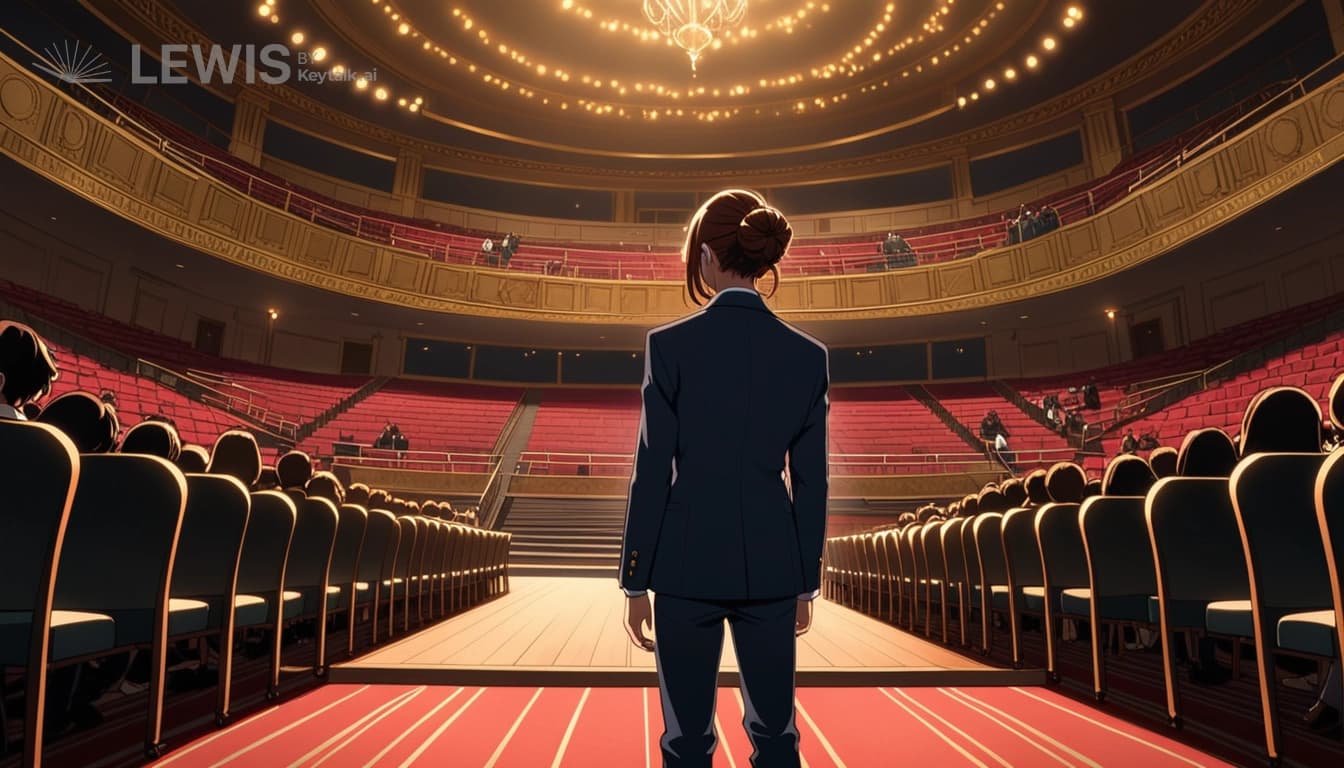
The academy’s grand rehearsal auditorium—ornate, echoing, and flooded with harsh stage lights. Rows of empty velvet seats stretch into the darkness, interrupted only by a handful of faculty and rival students gathered for the high-stakes competition run-through.

[Time]
Late afternoon, the eve before the citywide competition. The auditorium hums with tension, anticipation, and the crackle of barely-contained rivalries.

[Action]
Lucía, Anaís, and Diego arrive for their joint rehearsal, tense after the vulnerable rooftop truce and still raw from the fallout with Diego. The space is charged: faculty members watch, assessing every move; rivals glare from the wings, eager for missteps. Lucía feels the weight of her family’s future and the scrutiny of the academy, fueling her determination but fraying her nerves. Diego, fighting for his crew’s legitimacy, is on edge, his percussion sharp and defiant. Anaís masks her anxiety behind practiced poise, but her hands tremble as she tunes her violin—a private signal Lucía now recognizes.

They begin their piece—a daring fusion of classical, street, and experimental elements. Tension mounts as they push past the limits of rehearsal, each performer trying to prove something: Lucía her belonging, Diego his worth, Anaís her control. The music escalates, their chemistry volatile. Suddenly, Anaís’s magic—barely contained since childhood—erupts. Her violin unleashes a storm of sound, the music twisting into something wild and dangerous. The auditorium’s windows rattle, glass fractures, and for a suspended moment, everyone is caught in the spell of impossible music.

Panic follows. Teachers and students are stunned, some fearful, others calculating the implications. Word spreads instantly—rumors of a “supernatural incident” ignite across campus and online. Anaís, shaken and exposed, is paralyzed by the realization that her secret is out. Lucía, acting on instinct, steps forward as Anaís’s shield—claiming the outburst was a technical malfunction, deflecting suspicion even as she’s shaken to her core. Diego, torn between shock and loyalty, hesitates—he knows what he witnessed, but is forced into complicity by Lucía’s plea.

In the aftermath, the trio is pushed into a private confrontation. Lucía demands answers, Anaís is torn between confession and fear, and Diego struggles with his own sense of betrayal. The auditorium, once a place of ambition, becomes a battleground of secrets, trust, and survival as their alliance is tested at its breaking point.

[Impact on the story]
This scene explodes the fragile trust built on the rooftop: Anaís’s secret is no longer theoretical, forcing Lucía and Diego to make immediate, high-stakes choices about loyalty, truth, and self-preservation. Lucía’s instinct to protect Anaís marks a turning point in their relationship, binding them with real stakes. Diego’s hesitation foreshadows his coming crisis of conscience. The magical outburst raises the competition’s stakes from personal to existential, setting the trio apart—and painting a target on their backs as the academy and city turn their attention to what really happened on that stage.

[Description]
During a high-pressure rehearsal, Anaís’s suppressed magic erupts, shattering glass and exposing her secret to Lucía, Diego, and the academy’s elite. The trio must scramble to contain the fallout, forcing them into a new, perilous alliance as the city’s rumor mill explodes and the line between friend and threat blurs forever.
scene 6 image
Scene 6
[Title]
The Wild Track: Viral Betrayals and the Night When Everything Burns

[Place]
Backstage labyrinth of the city’s main concert hall—narrow, pulsing with adrenaline, crowded with rivals, family, and press. The air smells like rosin, sweat, and tension. The competition stage is just beyond the curtain, ablaze with spotlights and the restless hum of the crowd.

[Time]
Night of the citywide music competition, minutes before and during the trio’s performance. The city outside is electric, alive with rumors and expectation.

[Action]
The trio—Lucía, Anaís, and Diego—arrives at the venue, each haunted by the fallout from the magical incident. The academy’s administration circles, scrutinizing Anaís with suspicion, while Lucía’s mother waits anxiously in the wings, fearing for their future. Tensions are at a breaking point: Lucía is desperate, fiercely protective, yet shaken by her own doubts about Anaís and the cost of their alliance. Anaís, now an object of whispered fear and fascination, faces the ultimate test—not just to perform, but to control the dangerous magic within her. Diego, feeling betrayed and isolated after the last rehearsal, is torn between loyalty to his friends and his anger at being forced into complicity.

As the trio prepares, rival musicians attempt last-minute sabotage—a broken drumstick, a sabotaged bow, whispered threats about Anaís’s “unnatural” talent. The stakes are no longer just the competition or scholarships, but survival in a city hungry for spectacle and scandal. Lucía confronts Diego about his distance, forcing a raw, vulnerable exchange about trust and what’s worth risking for each other. Meanwhile, Anaís’s family arrives, their presence chilling: her mother’s icy warning makes clear that failure tonight means exile, exposure, or worse.

The climax unfolds as Diego’s leaked demo track—an unauthorized recording of their fused style, now viral across social media—echoes through the concert hall, hijacking the event and making their performance the centerpiece of the night. The crowd is wild, the judges divided. With no way back, the trio decides to perform the demo live, unleashing a spellbinding set that blends street, classical, and Anaís’s barely-contained magic. The performance is chaotic, raw, and unforgettable—music as both rebellion and confession.

During the piece, Anaís loses control again, but this time Lucía and Diego help her channel the magic instead of suppressing it. The auditorium is transformed: lights flicker, the audience is breathless, and for one impossible moment, their music feels like revolution. Afterwards, chaos erupts—academy officials threaten to disqualify them, Anaís’s family tries to spirit her away, and Lucía’s family faces eviction as retribution for the scandal. Diego’s crew is banned, but their performance has already made them legends.

In the confusion, Lucía, Anaís, and Diego must decide whether to run, fight, or face the consequences together. Their bond is battered but unbreakable—each has sacrificed something irreplaceable for the others. As the city outside buzzes with their names and the future hangs on a knife edge, the trio steps into the unknown, changed forever by the night when music burned down every rule.

[Impact on the story]
This scene delivers the emotional and narrative climax: all secrets and alliances are laid bare, forcing Lucía, Anaís, and Diego to either break apart or stand together against overwhelming odds. Their collective choice to risk everything for one another marks the birth of something new—friendship, love, or revolution—and sets up the uncertain aftermath. The viral performance cements their legend but also ensures they can never return to who they were.

[Description]
On the night of the competition, sabotage and betrayal push Lucía, Anaís, and Diego to risk everything. Their viral, magical performance makes them instant icons but shatters their old lives, forcing them to choose: escape, surrender, or fight for each other in a world that now sees them as both heroes and threats.
'Engaged to the Muse'Story Chat

Want to chat with the characters from this story?

'Engaged to the Muse'Story Chat

Want to chat with the characters from this story?

story image
story image
story image

You might also like

Comments0

rank icon image
#1 inGenre
rank icon image
#1 inGenre
rank icon image
#1 inGenre
theme music