
본문으로 건너뛰기
Mother vacuuming  cover image

Mother vacuuming

Set against the backdrop of a sunlit afternoon, a mother's tranquil routine gives way to an emotional storm as her son's innocent play results in the rupture of a treasured vase. In the aftermath of the accident, emotions flare and tears flow, each shard of porcelain embodying years of unspoken familial strife. As she methodically cleans the scene with the hum of the vacuum drowning out her child’s muffled sobs, the mother is propelled into an introspective journey, re-evaluating her role as a parent and the pressures of maintaining a facade of perfection.

Weekly ranking

rank icon image
#2 inConcept
rank icon image
#43 inGenre
Scroll

Plot Synopsis

On a luminous afternoon, Margaux Delacroix stood in her immaculate kitchen, the hum of the dishwasher blending seamlessly with the ticking clock on the wall. The air was heavy with lavender, her signature scent, masking the faint aroma of freshly cut grass wafting in from the backyard. Her son, Jacob, played nearby, his chaotic energy a stark contrast to the museum-like order of their suburban home. Margaux, lost in the rhythm of her routine, barely noticed the thunderous crash until it was too late. She turned, her heart sinking, to find Jacob frozen in the living room, wide-eyed and trembling, a jagged sea of porcelain at his feet. The vase—a gift from her late grandmother, a relic of both sentimental and aesthetic perfection—lay irreparably shattered. For a moment, the world seemed to hold its breath.

The boy’s apology tumbled out in gasps, his words colliding with each other in a panic. But Margaux remained silent, her expression unreadable as she surveyed the wreckage. Inside, a storm churned—a mixture of grief, fury, and something darker, a gnawing sense of failure that she couldn’t yet name. Jacob’s innocent mistake was a mirror she hadn’t asked for, reflecting the impossible standards she had built for herself and, by extension, for him. As she reached for the vacuum, her movements were mechanical, her focus narrowed to the task at hand. Jacob’s muffled sobs faded into the background, overtaken by the roar of the machine. Yet, with each shard she swept away, Margaux felt the brittle edges of her carefully curated life pressing against her chest, threatening to pierce through.

The tension lingered long after the room was restored to its pristine state. That evening, Margaux retreated to her garden, seeking solace among the imperfect blooms she tended in secret. Her hands, accustomed to control, trembled as she traced the petals of a rose, her mind replaying the incident. She thought of her own childhood, of the cold silences and clipped reprimands that had shaped her. Was she becoming her mother, wielding perfection as both shield and weapon? Jacob, meanwhile, sat in his room, clutching a toy knight as though it could protect him from the weight of his guilt. He didn’t understand the full extent of his mistake, only that he had disappointed the one person whose approval meant everything.

The following day, Margaux found herself in a ceramics studio, the shattered vase wrapped in newspaper under her arm. She hadn’t planned to salvage it but was inexplicably drawn to Luca Bellini, a local artisan whose reputation for restoring fragile treasures had reached her through whispered recommendations. Luca’s workshop was a stark contrast to her home—cluttered yet alive, filled with half-finished pieces that bore the scars of their creation. As she explained the situation, her voice faltered, and Luca, with his quiet intensity, noticed the fracture lines in her composure. He agreed to restore the vase but warned her that it would bear the marks of its breakage, a testament to its history rather than a return to its original state. Margaux bristled at the idea but reluctantly agreed, her curiosity piqued by the man’s unspoken philosophy.

Over the weeks that followed, Margaux visited Luca’s studio under the pretense of checking on the vase’s progress. In truth, she was drawn to the meditative quality of his work, the way he embraced imperfection as intrinsic to beauty. They spoke in fragmented conversations, Luca’s dry humor occasionally breaking through her guarded facade. Through him, she began to see her own life in the context of kintsugi—the Japanese art of repairing broken pottery with gold, where the cracks become part of the piece’s story rather than something to be concealed. Meanwhile, Jacob, sensing his mother’s distraction, ventured deeper into his imaginative worlds, crafting elaborate adventures in the backyard where knights and dragons fought for honor. Yet, his play was tinged with a newfound caution, an unspoken fear of causing more harm.

The turning point came one evening when Margaux returned home to find Jacob in the living room, holding a cracked teacup she had planned to discard. He had glued it back together, his small hands sticky with paste, the seams jagged but earnest. “I fixed it,” he said, his voice quivering with both pride and trepidation. Something inside Margaux broke open. She knelt beside him, tears streaming down her face as she cradled the imperfect cup. In that moment, she saw not just the cup, but the quiet resilience of her son—the way he sought to mend what he had broken, even if the result was flawed. It was a reflection of herself, of the woman she could become if she let go of her relentless pursuit of perfection.

When Luca finally returned the vase, its golden
Model Used
GPT-4o
text
Stable Diffusion
image

Story Details

Keytalk Prompts Used
See all Keytalks
no chosen prompts
no chosen prompts
no chosen prompts
no chosen prompts
no chosen prompts
no chosen prompts
Model Used
GPT-4o
text
Stable Diffusion
image

Character

Protagonist Character

Margaux Delacroix

GenderFemale
OccupationMother

Profile

Margaux Delacroix is a woman of carefully constructed poise, a figure whose outward tranquility often masks the turbulent undercurrents of her inner world. At 39, she is the kind of mother whose presence fills a room not with warmth, but with an almost imperceptible hum of tension—an unspoken expectation that everything, and everyone, must align with a silent ideal. Her chestnut hair, always pinned back into a sleek twist, betrays not a strand out of place, much like her meticulously curated home, where every object seems to have been arranged with the precision of a museum exhibit. Margaux is a perfectionist to a fault, her attention to detail both her strength and her undoing. Her eye for aesthetics—honed during a brief but formative stint in interior design before motherhood consumed her identity—translates into a knack for creating beauty, though often at the cost of spontaneity or joy.

Raised in the shadow of a domineering mother and a father who buried himself in work to avoid confrontation, Margaux learned early in life that control was her sanctuary. Her childhood was a silent apprenticeship in emotional suppression, her adult life a masterclass in wielding that skill to maintain an image of seamless competence. Her own home, a modest yet aspirational suburban haven, is her canvas, and her son—her only child—is the centerpiece of her devotion. Yet, beneath her polished exterior lies a woman quietly unraveling, her days defined by an unspoken fear that she is failing at the very role she has built her life around. She often wonders, in the still moments when no one is watching, whether her obsession with appearances has left her son with a mother who is present but emotionally opaque.

Margaux’s aspirations are deceptively simple: she wants to be seen as a "good mother," though the definition of that title shifts like a mirage in her mind. Her motivations are tangled with both love and insecurity, a genuine desire to nurture her son shadowed by an ingrained need to live up to the invisible scorecard she imagines the world holds against her. Her speech is deliberate and formal, her words often chosen with the precision of someone used to sidestepping confrontation. However, in moments of stress, a clipped sharpness edges her tone, betraying the fragility beneath her calm exterior. She is not one to raise her voice, but her silences can carry the weight of a thousand unspoken criticisms.

Though Margaux strives to project an image of control, cracks in her armor reveal her humanity. She has a secret fondness for gardening, a hobby she indulges in the early hours of the morning when the world is still and no one can judge her imperfectly pruned roses. She is talented at restoring old objects, particularly porcelain, though she finds it ironic that her hands can mend what her heart cannot. She often carries a faint scent of lavender, a fragrance she associates with comfort but also with the suffocating expectations of her childhood home.

Her greatest challenge lies in her inability to relinquish the facade of perfection, a flaw that blinds her to the quiet beauty of imperfection—both in herself and in others. Margaux is a protagonist whose journey will be defined by her need to reconcile the carefully polished image she presents to the world with the raw, flawed, and deeply human woman beneath. Her story is one of painful self-discovery, where each decision she makes will force her to confront the delicate balance between order and chaos, love and control, vulnerability and strength.

Antagonist Character

Jacob

GenderMale
OccupationSon

Profile

Jacob is a wiry, restless nine-year-old boy with perpetually scuffed knees and an uncontainable energy that seems to ripple just beneath his skin. His face is an open book of unfiltered emotion—his wide, almond-shaped eyes often betraying a flicker of curiosity or guilt before he even utters a word. Jacob’s speech is a cascade of half-formed thoughts, spoken in a breathless rush, his words tumbling over each other with the urgency of a child who fears the world might move too quickly for him to keep up. Though his tone is informal and peppered with exaggerated expressions and exclamations, it carries an earnestness that’s disarming. He has a habit of biting his lower lip when nervous, a subtle, unconscious tell that reveals his internal struggle to please others while remaining true to his impulsive nature.

Jacob is, at his core, a dreamer—prone to losing himself in the elaborate stories he concocts during his solitary play. His creativity is boundless, and his ability to repurpose the mundane into the extraordinary often leaves adults marveling at the peculiar connections he makes. However, his imagination can be both his gift and his curse. It fuels his charm and resourcefulness but also leads him into trouble, as he frequently underestimates the consequences of his actions. There’s a streak of defiance in him, a quiet rebellion against rules he doesn’t fully understand, though this is tempered by an innate desire for approval—particularly from his mother, whose love he both craves and fears losing.

Jacob lives in a modest suburban home, where the hum of a structured routine often clashes with his chaotic tendencies. His world is largely confined to the backyard, where he crafts his own kingdoms out of sticks and stones, and the living room, where he’s drawn to the fragile objects he’s been sternly warned to avoid. He is a child caught between innocence and the budding awareness of the world’s fragility, grappling with the unspoken tensions that linger like ghosts in the corners of his home. Though he wouldn’t articulate it in such terms, Jacob senses the weight of expectations pressing against him, and it leaves him teetering between joyful abandon and a nascent insecurity.

At school, Jacob is the kind of child who alternates between being the ringleader of mischief and the quiet observer in the corner. He’s bright but distractible, his attention often flitting away like a bird startled by the wind. While he has a knack for inventing games and rallying classmates into his orbit, his relationships remain surface-level, as he’s never quite certain how to navigate the complexities of deeper connections. His mother is his anchor, though his perception of her is tinged with awe and fear—a mixture of admiration for her poise and anxiety over her disapproval.

Jacob’s greatest challenge lies in his fledgling understanding of consequences. He is not malicious but is often reckless, his actions stemming from a blend of curiosity and an inability to foresee the ripple effects they might cause. His motivations are pure, driven by an untainted desire to explore and create, but his youthful ignorance leaves him vulnerable to moments of unintended chaos. Yet, beneath the surface, there is a flicker of self-awareness beginning to take root, a quiet recognition that his actions carry weight and that the world—and the people in it—are more fragile than he once believed.

As a supporting character in the story, Jacob’s role is pivotal, though he is not the antagonist in the traditional sense. Instead, he acts as a catalyst, his actions inadvertently forcing his mother into a confrontation with her own vulnerabilities. His innocence and impulsivity provide a stark contrast to her carefully constructed facade of perfection, and through his mistakes, he becomes the unwitting mirror that reflects her deepest fears and unspoken truths. Jacob’s youthful exuberance and flaws are not only integral to the unfolding narrative but also hold the potential to shift the emotional axis of the story, offering both conflict and the possibility of reconciliation.
Sidekick Character

Luca Bellini

GenderMale
OccupationCeramics Artisan

Profile

Luca Bellini, a 27-year-old ceramics artisan, carries the quiet intensity of someone who has spent countless hours shaping the unforgiving medium of clay, his hands calloused but deliberate, his gaze often distant as though perpetually sculpting something unseen. He is a man of meticulous precision, his workbench a reflection of his inner world—tidy, but marked by smudges of imperfection that speak to both his artistry and his humanity. Raised in a modest household where practicality often overshadowed passion, Luca’s choice to pursue ceramics was an act of quiet rebellion, a declaration of his belief that beauty need not justify itself. His speech is measured, laced with a faint Italian cadence that softens his otherwise reserved demeanor, though he has a tendency to grow curt when his vulnerability is probed. Luca’s dedication to his craft borders on obsession, a strength that has earned him recognition in niche art circles but also isolates him from those who wish to know him beyond his work. Beneath his calm exterior simmers a restlessness—an unspoken fear that his life, meticulously constructed like one of his vases, is as fragile as the pieces he creates. He harbors a deep-seated reluctance to confront his own emotional fractures, preferring instead to channel his disquiet into the kiln’s fire, where he believes transformation is possible. Though he avoids conflict, his sharp wit and dry humor can unexpectedly surface in moments of candor, surprising even himself. Luca’s quiet charisma and latent idealism make him a compelling supporting character in the story, a catalyst for introspection and growth for those who cross his path, while his own unacknowledged wounds hint at a yearning for connection he has yet to fully admit.
Model Used
GPT-4o
text
Stable Diffusion
image

World

1. Where/When:
The story is set in a meticulously curated suburban neighborhood in modern-day France, where time seems to flow with the precision of a well-oiled clock. The events unfold primarily over the span of several weeks, beginning on a luminous spring afternoon when the air is tinged with the scent of blooming lavender and freshly cut grass. The Delacroix home, with its polished hardwood floors and carefully arranged décor, reflects Margaux’s obsession with order and perfection, serving as both sanctuary and prison. Meanwhile, Luca Bellini’s ceramics studio, tucked away in a quieter, less pristine part of the town, exists as a counterpoint—a space of creative chaos and raw authenticity. The backdrop of these contrasting environments mirrors the psychological terrain of the characters: the tension between control and vulnerability, perfection and imperfection, fracture and repair.

2. Important rules of the universe and how it impacts the story:
This universe operates under the unyielding societal expectation of maintaining appearances, particularly within the microcosm of suburban life. Here, perfection is not just an aspiration but an unspoken rule—one that dictates the rhythms of daily existence and places immense pressure on individuals, especially women, to conform. Margaux’s world is one where every detail is scrutinized, from the pristine state of her home to the behavior of her child, creating an environment where vulnerability is equated with failure.

However, the story introduces a counter-rule, embodied in the philosophy of kintsugi—the Japanese art of repairing broken pottery with gold, embracing flaws as part of an object’s history rather than erasing them. This philosophy, which Luca lives and breathes through his work, challenges the rigid framework of Margaux’s life, offering an alternative lens through which to view imperfection. The collision of these two worldviews—one rooted in suppression, the other in acceptance—drives the emotional and thematic undercurrents of the narrative.

This universe also imposes the rule of intergenerational influence, where the unresolved emotional patterns and expectations of one generation ripple into the next. Margaux’s upbringing under a domineering mother and emotionally absent father shapes her approach to parenting, creating a cycle of suppressed emotions and unattainable standards that Jacob, in his youthful innocence, begins to resist. The story’s ultimate question is whether Margaux can break free from this cycle, embracing the beauty of imperfection in herself and her son.

3. The visual description of the universe:
The Delacroix home is a symphony of muted elegance, where every room seems plucked from the pages of an upscale interior design magazine. Soft, neutral tones dominate the palette—whites, beiges, and pale grays—accentuated by carefully chosen pops of color, such as the deep blue of the shattered vase. The living room is dominated by sharp lines and symmetrical arrangements, from the precisely aligned cushions on the sofa to the gleaming surfaces devoid of fingerprints. Yet, this immaculate order is oppressive rather than inviting, the kind of beauty that demands admiration but denies comfort.

Outside, the backyard is a quiet rebellion against the house’s rigidity—a place where Jacob’s imaginative play transforms sticks into swords and patches of dirt into battlefields. The garden, Margaux’s secret refuge, is a space of understated imperfection. The roses bloom unevenly, their petals occasionally marred by insects, but this raw, untamed beauty offers her a fleeting sense of peace.

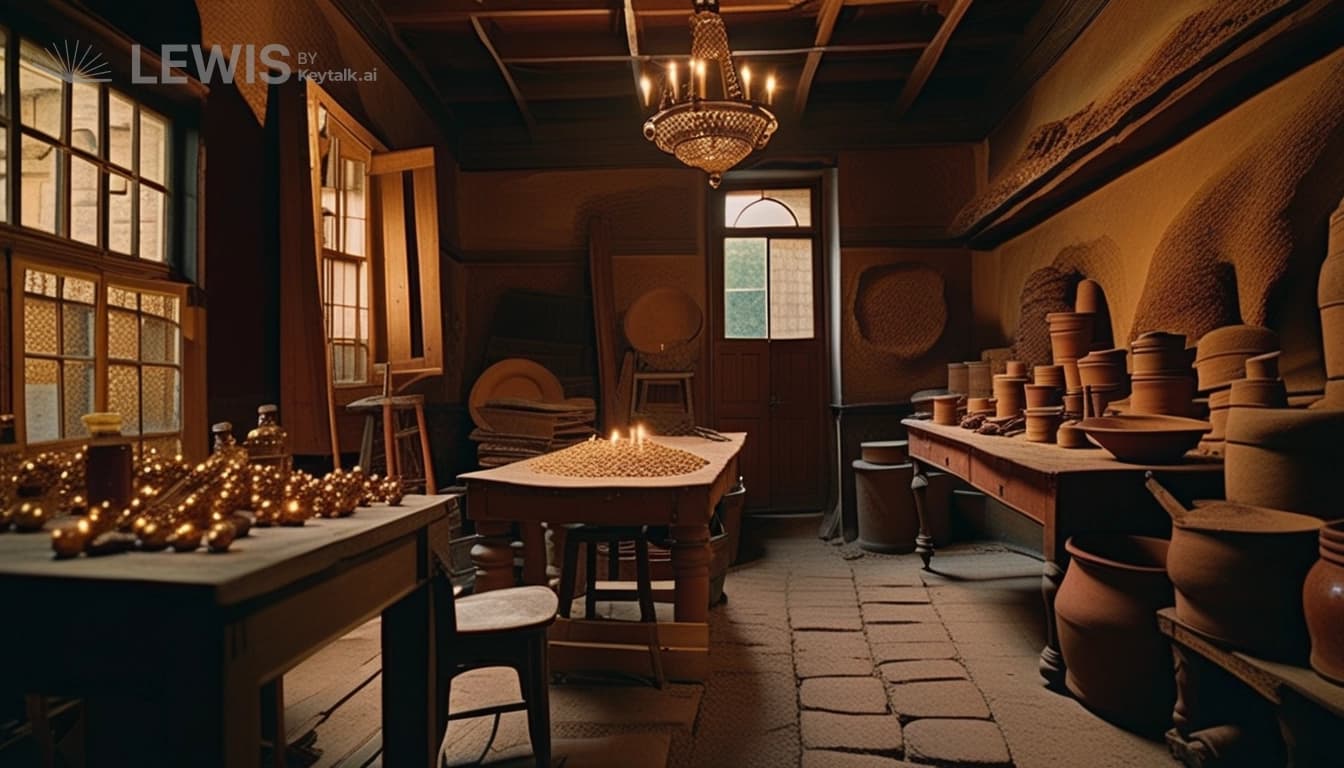
Luca’s ceramics studio, by contrast, is a kaleidoscope of textures and colors. The air carries the earthy scent of clay mixed with the faint tang of kiln smoke, and the space is alive with the quiet hum of creativity. Half-finished pieces crowd the shelves, their surfaces bearing the irregularities of human touch. Pots of glaze in vibrant hues sit beside tools worn from use, and the light filtering through dusty windows casts a golden glow over the room. This is a place where perfection is not imposed but emerges organically from the process of creation—and where Margaux begins to confront the fractures in her own life.

4. Notable technologies or philosophies of the universe that impact the story:
The most significant philosophy shaping the narrative is kintsugi, which serves as both a literal and metaphorical framework for the story. This ancient Japanese art form involves repairing broken pottery with lacquer mixed with powdered gold, silver, or platinum, highlighting rather than hiding the cracks. The philosophy behind kintsugi is one of resilience and transformation, embracing imperfection as a testament to an object’s history and endurance. Luca’s mastery of this craft not only impacts the restoration of Margaux’s shattered vase but also becomes a lens through which she begins to reframe her own life. The idea that brokenness can be beautiful challenges her deeply ingrained belief that perfection is the only measure of worth.

Additionally, the universe subtly incorporates modern-day conveniences and technologies, such as the vacuum cleaner that drowns out Jacob
representative image
location 1 image

Location 1

- Title : The Lavender Garden of Rue Saint-Claire
- Description: Nestled behind wrought-iron gates, the garden was a sanctuary of unruly beauty, its lavender bushes spilling over cobblestone paths in fragrant defiance of Margaux’s controlled world. The late-afternoon sun bathed the blooms in a golden haze, their violet hues swaying gently in the breeze as bees hummed in hypnotic rhythms. Here, amid the imperfect blossoms and whispering branches, Margaux wrestled with the ghosts of her upbringing, her trembling hands tracing the soft petals as if searching for answers they couldn’t provide.
location 2 image

Location 2

- Title: Luca Bellini’s Atelier of Golden Scars
- Description: Tucked into a cobblestone alley, Luca’s atelier exudes a quiet, chaotic charm—shelves overflow with fractured ceramics, their edges glinting faintly with veins of gold. The air is thick with the earthy scent of clay and varnish, mingling with the faint strains of a mournful violin playing on an old record player. Margaux, seated at a weathered workbench, watches as Luca’s steady hands piece together her shattered vase, his deliberate movements a silent sermon on the beauty of imperfection.
location 3 image

Location 3

- Title: The Sunlit Living Room of Fragile Order
- Description: Bathed in the gentle afternoon glow, the living room exuded an almost sterile perfection—polished wooden floors reflecting the sunlight, minimalist furniture arranged with surgical precision. Yet, amidst this curated calm, the jagged edges of a shattered porcelain vase lay scattered like tiny wounds, their gleaming fragments a stark rebellion against the room’s rigid symmetry. In the silence that followed the crash, the air seemed heavier, as though the room itself mourned the fragile illusion it could no longer uphold.
Model Used
GPT-4o
text
Stable Diffusion
image

Scenes

scene 1 image
Scene 1
- Title: The Shattered Vase
- Place: Margaux's suburban home, specifically the living room.
- Time: A luminous afternoon.
- Action: Jacob accidentally knocks over and shatters Margaux's late grandmother’s cherished porcelain vase, causing an emotional storm within Margaux as she silently cleans up the mess.
- Impact: The incident acts as a catalyst, exposing the fragile, suffocating perfection Margaux has imposed on her life and planting the seeds of self-reflection.
- Description: Amid the hum of a pristine household, chaos erupts when Jacob’s innocent clumsiness reduces a treasured heirloom to shards, leaving Margaux grappling with suppressed grief, mounting frustration, and the haunting realization of her own unattainable standards.
scene 2 image
Scene 2
- Title: Mechanical Movements
- Place: Margaux's suburban home, primarily the living room and kitchen.
- Time: Late afternoon, transitioning into evening.
- Action: Margaux cleans the shattered vase with robotic precision, her inner turmoil masked by her methodical actions, while Jacob retreats to his room, overwhelmed by guilt and fear.
- Impact: Margaux’s mechanical response to the incident deepens the emotional divide between her and Jacob, as both grapple silently with the weight of their respective feelings—Margaux with her perfectionism and Jacob with his perceived failure.
- Description: The vacuum’s roar drowns Jacob’s muffled sobs as Margaux sweeps up the shards, her face a mask of calm concealing an internal tempest; later, Jacob clutches a toy knight in his dimly lit room, seeking solace from the guilt that shadows him.
scene 3 image
Scene 3
- Title: Reflections in the Garden
- Place: Margaux’s backyard garden, surrounded by her meticulously tended flowers.
- Time: Evening, under the fading light of dusk.
- Action: Margaux escapes to her garden, her hands trembling as she tends to the delicate blooms, while memories of her mother’s cold perfectionism resurface; Jacob remains secluded in his room, grappling with his guilt and the fear of his mother’s judgment.
- Impact: The garden becomes a space where Margaux begins to confront the parallels between her upbringing and her own parenting, while Jacob’s isolation deepens, creating an emotional chasm between them.
- Description: The air is thick with the scent of roses as Margaux’s fingers trace their petals, her mind a storm of self-recrimination and doubt; Jacob, alone in the dim glow of his room, clings to his toy knight, his small frame curled with the weight of unspoken remorse.
scene 4 image
Scene 4
- Title: The Artisan's Workshop
- Place: Luca Bellini’s ceramics studio, a cluttered yet vibrant space filled with half-finished pottery and tools.
- Time: Late morning, sunlight streaming through dusty windows, illuminating the golden motes dancing in the air.
- Action: Margaux brings the shattered vase to Luca, who agrees to repair it but warns her that its cracks will remain visible; Margaux is both intrigued and unsettled by his philosophy of embracing imperfection. Their brief, hesitant conversation marks the beginning of a connection as Margaux becomes quietly captivated by his deliberate, unhurried approach to his craft.
- Impact: Margaux begins to question her rigid ideals of perfection, drawn to the idea that brokenness can carry its own form of beauty, though she is not yet ready to embrace it fully.
- Description: The room hums with subdued energy, the scent of clay and varnish mingling with the crisp tang of coffee. Luca’s hands move deftly over the broken vase, his calm demeanor a stark contrast to Margaux’s tension. Sunlight catches the fractured porcelain, casting sharp, glinting shadows as Margaux’s carefully curated facade begins to crack in the presence of this quiet, unapologetic chaos.
scene 5 image
Scene 5
- Title: Embracing Imperfection
- Place: Margaux’s suburban home, particularly the garden and later the living room, where sunlight filters through the blinds, casting fractured patterns on the walls.
- Time: Early evening, a soft golden hour glow suffusing the air with a quiet warmth, juxtaposed against the simmering tension in Margaux’s chest.
- Action: Margaux reflects on Luca’s philosophy of imperfection while tending to her garden, her mind still wrestling with the idea of visible cracks as beauty. She accidentally crushes a budding flower, triggering a cascade of emotions that leads her to confront her rigid need for control. Later, she tentatively embraces the concept by displaying a visibly flawed teacup Jacob had repaired, placing it prominently on a shelf as an unspoken gesture of acceptance.
- Impact: This marks Margaux’s first conscious step toward relinquishing her obsession with perfection, signaling a shift in her relationship with herself and her son. Her decision to display the flawed teacup shows her willingness to value intention and effort over unattainable ideals.
- Description: The garden hums with life—bees dart between blossoms, and the scent of earth mingles with lavender, but Margaux’s hands tremble as they brush against the torn petals of the crushed flower. In the living room, the teacup gleams faintly under soft lamplight, its jagged seams stark yet oddly comforting—a fragile, imperfect symbol of something newly mended within her.
scene 6 image
Scene 6
- Title: The Mended Cup
- Place: Margaux’s living room, where the flawed teacup sits on the shelf, and Jacob’s bedroom, dimly lit with the soft glow of a nightlight shaped like a dragon.
- Time: Late evening, a quiet stillness enveloping the house, broken only by the muffled rustle of leaves outside and the steady tick of the clock.
- Action: Margaux finds Jacob asleep, clutching his patched-up teacup like a talisman, and whispers a promise to him—one of patience and understanding—before placing the restored vase with its golden seams beside the teacup on the shelf.
- Impact: Margaux’s gesture solidifies her transformation, fully embracing imperfection as a mark of growth, while the symbolic placement of the vase and teacup bridges her relationship with Jacob, fostering a newfound tenderness.
- Description: The vase gleams softly in the lamplight, its golden veins intertwining like threads of forgiveness, while Jacob’s tiny fingers curl protectively around the teacup—a tableau of fragile yet profound reconciliation.
'Mother vacuuming 'Story Chat

Want to chat with the characters from this story?

'Mother vacuuming 'Story Chat

Want to chat with the characters from this story?

story image
story image
story image

You might also like

Comments0

rank icon image
#2 inConcept
rank icon image
#24 inGenre

Recommendation from YLAB Town

theme music