본문으로 건너뛰기
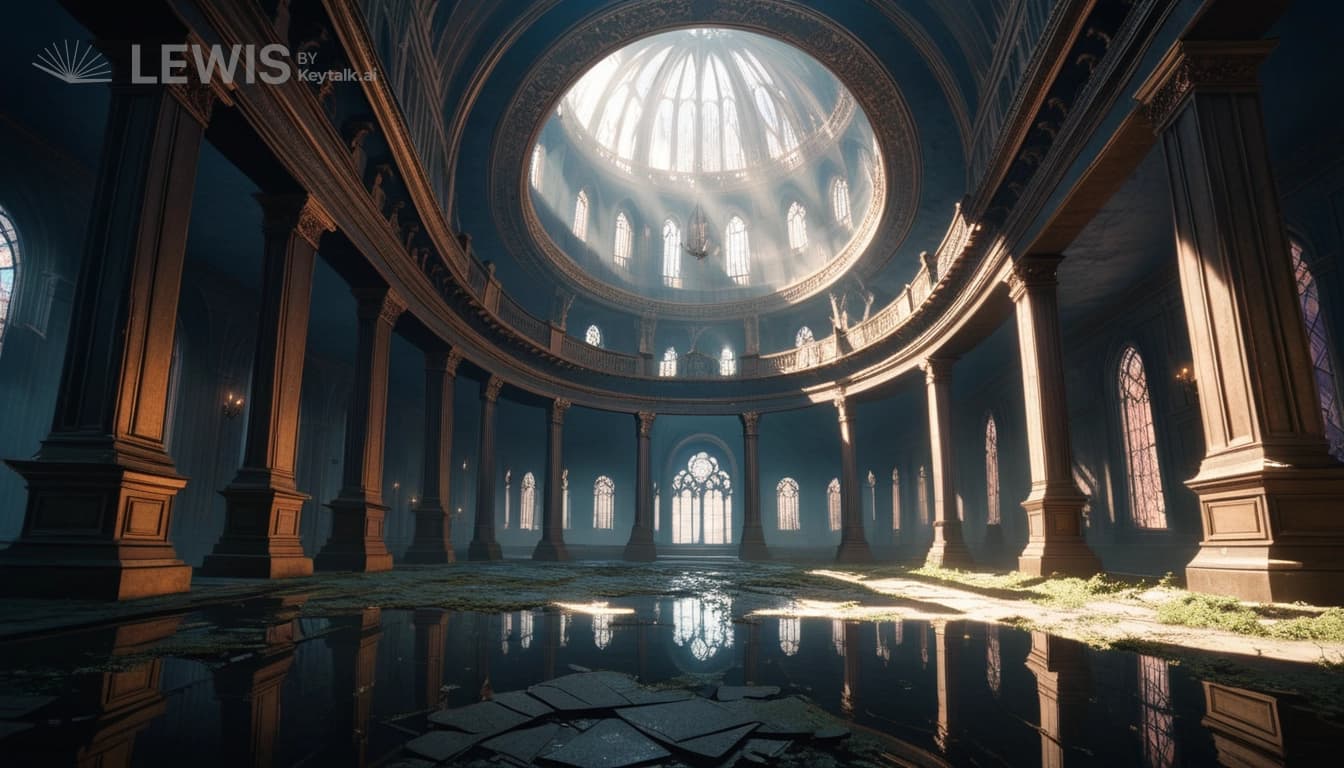
Reflections of the Fractured Veil cover image

Reflections of the Fractured Veil

A brilliant quantum physicist, haunted by the loss of her partner, stumbles upon a portal to an eerie dimension where every surface mirrors her deepest fears and regrets. As cosmic anomalies begin to seep into our world, she is confronted by the terrifying possibility that these echoes of her dark past could obliterate both her present and future unless she can unravel the mysteries lurking within this reflection-strewn realm.

Weekly ranking

rank icon image
#3 inConcept
rank icon image
#42 inGenre
Scroll

Plot Synopsis

Zofia Krawiec, a renowned quantum physicist whose brilliance is rivaled only by the depths of her grief, has spent years entombed in her research, seeking solace in the sterile precision of equations and the abstract beauty of the cosmos. Her partner’s death—a sudden, cruel event that shattered her sense of stability—remains a scar she refuses to touch, even as it silently colors every aspect of her existence. Late one night, in her cluttered apartment, Zofia stumbles upon an anomaly during a routine experiment. A fleeting distortion in her equipment leads her to uncover an impossible phenomenon: a portal, shimmering like liquid glass, suspended in the air. It beckons her with an inscrutable allure, and her fascination quickly eclipses her caution. As she probes its boundaries, she realizes the portal is not merely a passage—it is a mirror to an otherworldly dimension where the laws of physics twist into haunting reflections of human anguish. On the other side, the landscape is a kaleidoscope of her fears and regrets, a place where her partner’s absence manifests as spectral echoes that grow increasingly vivid.

Determined to understand the portal’s origins and implications, Zofia reluctantly reaches out to Viktor Dragović, a theoretical physicist whose reputation teeters precariously between genius and lunacy. Viktor, an aloof figure haunted by his own failures and estranged from his family, agrees to assist her—not out of altruism but for the chance to confront the enigmas that have eluded him. Their collaboration is tense, fraught with philosophical clashes and the friction of their opposing temperaments. Viktor’s obsession with chaos theory and his cryptic sketches of geometric patterns begin to align disturbingly with the portal’s behavior. The two physicists uncover unsettling truths: the dimension is not simply a reflection of Zofia’s psyche, but a reactive entity capable of feeding on human vulnerability. As the portal’s influence grows, anomalies begin leaking into their own world—time warps, localized gravitational distortions, and objects behaving as though governed by alien rules. Zofia’s antique clocks stop ticking, their mechanisms folding inward, as if consumed by the weight of her sorrow.

The stakes escalate when Sergei Volkov, an experimental mathematician whose unorthodox methods have earned him both acclaim and exile, joins their efforts. Sergei’s brusque demeanor and relentless focus make him an invaluable asset, though his arrogance often grates on Zofia and Viktor. His calculations reveal a chilling discovery: the dimension is expanding, its reflective surfaces multiplying across their reality like an infection. The trio realizes that if left unchecked, the dimension’s echoes—manifestations of their own dark pasts—could consume the physical world, rewriting the very fabric of existence into a grotesque tableau of human despair. Zofia struggles to maintain her composure as images of her partner appear in the mirrors, taunting her with half-formed whispers and glimpses of moments she regrets. Viktor’s sketches, once abstract, now eerily resemble the portals’ fractal patterns, suggesting that his mind is becoming entangled with the dimension’s logic. Sergei, for all his brilliance, begins to falter under the weight of his own buried failures, his muttered calculations growing increasingly frantic.

As the anomalies intensify, Zofia confronts the terrifying realization that the dimension’s expansion is not random—it is tethered to her unresolved grief. Her relentless pursuit of understanding, her refusal to confront her partner’s death, has inadvertently strengthened the portal’s connection to her psyche. Viktor, whose own life is a mosaic of regret, argues that their only chance of survival lies in confronting the emotional wounds that bind them to the dimension. Sergei, ever pragmatic, proposes a mathematical solution: a calibrated collapse of the portal. The plan is risky and requires Zofia to cross into the dimension one final time to destabilize its core. The journey is harrowing, the mirrored landscapes twisting into grotesque parodies of her memories. She encounters an apparition of her partner, whose presence is agonizingly vivid yet fragmented, their voice fractured into incomprehensible syllables. Zofia’s resolve wavers, but she presses forward, guided by a desperate need to protect the world she has already sacrificed so much to understand.

The climax unfolds in a chaotic convergence of science and emotion. Viktor’s calculations falter as the dimension’s echoes begin to manifest physically, haunting their lab with surreal and violent apparitions. Sergei, overwhelmed by his own fears, retreats into a shell of bitter self-recrimination. Zofia, however, finds an unexpected reservoir of strength in the face of the dimension’s illusions. She realizes that the only way to sever its grip is to confront her partner’s death—not as a puzzle to solve or a wound to hide, but as an irreducible part of her humanity. In a moment of profound catharsis, she accepts the inevitability of loss and the imperfection of memory.

Model Used
GPT-4o
text
Stable Diffusion
image

Story Details

Keytalk Prompts Used
See all Keytalks
no chosen prompts
no chosen prompts
no chosen prompts
no chosen prompts
no chosen prompts
no chosen prompts
Model Used
GPT-4o
text
Stable Diffusion
image

Character

Protagonist Character

Zofia Krawiec

GenderFemale
OccupationQuantum Physicist

Profile

Zofia Krawiec is a woman defined by contrasts—her mind a sanctuary of precision and logic, yet her soul a tempest of unresolved grief. At thirty-six, she carries the poise of someone accustomed to navigating the labyrinthine complexities of quantum mechanics, but behind her sharp intellect lies an ache she masks with meticulous professionalism. Her angular features, framed by a cascade of dark auburn hair she often ties back in a loose braid, convey an understated beauty that she scarcely acknowledges. A native of Kraków, her speech is tinged with a faint Polish accent, her words deliberate and clipped, often laced with dry wit or cutting sarcasm. She avoids profanity, preferring the eloquence of carefully chosen phrases, but her tone can harden into something almost clinical when discussing matters that touch upon vulnerability. Zofia's fascination with the cosmos was born in childhood, nurtured by her father’s old astronomy books and long nights tracing constellations through an aging telescope. Yet it was the untimely death of her partner—an event she still struggles to speak of—that catalyzed her obsession with understanding the universe's deepest mysteries, as if decoding its laws might offer some semblance of solace. She now lives alone in a cramped yet immaculately organized apartment overlooking the edge of a bustling city, her workspace cluttered with chalkboards scrawled in equations and half-finished models of theoretical constructs. Outside her profession, Zofia harbors an unexpected passion for restoring antique clocks, a quiet rebellion against the fleeting nature of time. Driven by an almost ascetic dedication to her research, she often neglects her own needs, her meals reduced to coffee and whatever she can scavenge from the back of the fridge. Though outwardly composed, her mind teems with questions that border on existential—a yearning to reconcile the infinite possibilities of quantum states with the crushing finality of human loss. This relentless curiosity is both her armor and her Achilles’ heel, propelling her forward while leaving her blind to the emotional toll of her pursuits.
Antagonist Character

Viktor Dragović

GenderMale
OccupationTheoretical Physicist

Profile

Viktor Dragović, a 42-year-old theoretical physicist, bears the air of a man who has spent too much time contemplating the universe's cold indifference and not enough tending to the warmth of human connection. His tall, wiry frame seems perpetually hunched, as if the weight of abstract equations has physically imprinted itself upon him, and his pale, angular face is framed by unkempt black hair streaked with premature gray. Once a rising star in his field, his career has dwindled into a series of obscure, unpublishable papers that teeter on the edge of brilliance and madness—an ambiguity he neither shies away from nor acknowledges. Viktor speaks in clipped, precise sentences, his deep Slavic accent lending an austere gravity to his words, though his tendency to lapse into esoteric tangents often tests the patience of those around him. His mind is a labyrinth of contradictions: a skeptic who is drawn to the unknowable, a man of science haunted by an almost spiritual yearning to find meaning in the chaos of existence. He is prone to bouts of melancholia, exacerbated by a bitter divorce that left him estranged from his young daughter, whose laughter he recalls with a pang of guilt sharper than any failure in his work. Living alone in a sparsely furnished apartment cluttered with tattered notebooks, half-empty bottles of vodka, and relics of abandoned experiments, Viktor exudes an aura of quiet desperation, though he would bristle at any suggestion of weakness. His hands, perpetually stained with ink, betray a nervous energy he channels into cryptic sketches of geometric patterns—an old habit born from childhood nights spent trying to draw order out of chaos. Though he often projects an air of arrogance, dismissing colleagues with a sardonic quip or an impatient wave of his hand, there is an undercurrent of vulnerability in his gaze, as if he fears his life’s work might amount to nothing more than futile scribbles in the margins of an uncaring cosmos. Viktor will serve as a complex supporting character in Zofia’s journey, his own obsessions and fractured psyche acting as both a mirror to her struggles and a potential catalyst for her descent—or salvation—depending on which truths they dare to unearth together.
Sidekick Character

Sergei Volkov

GenderMale
OccupationExperimental Mathematician

Profile

Sergei Volkov, a 39-year-old experimental mathematician, is a man of quiet intensity, his presence marked by a peculiar blend of calculated precision and restless energy. His mind operates like a labyrinthine machine, endlessly churning through equations and theoretical models, yet his personal life is a tangle of contradictions. A former prodigy whose early brilliance earned him accolades, Sergei now finds himself in a self-imposed exile, retreating from the cutthroat academic circles he once thrived in. His apartment, a stark and claustrophobic space nestled in the heart of a city he regards with disdain, mirrors the cluttered state of his thoughts: books stacked precariously, notebooks scribbled with half-finished ideas, and cigarette butts crushed into an overflowing ashtray. Sergei’s speech is clipped, often laced with biting sarcasm and an undercurrent of impatience, though he occasionally lapses into a wistful softness when discussing abstract concepts like infinity or chaos theory. He is driven by a compulsion to uncover truths that lie beyond human comprehension, a pursuit that often borders on obsession. Despite his brilliance, Sergei is prone to bouts of self-doubt, haunted by the memory of a catastrophic failure that nearly cost him his reputation years ago. His relationships are sparse and strained, his brusque demeanor alienating those who might otherwise care for him, yet beneath his cynicism lies a yearning for connection he is too proud to admit. Sergei’s quirks include an inexplicable fondness for classical chess, though he plays as if waging war, and a tendency to mutter calculations under his breath during moments of stress. His unyielding curiosity and razor-sharp intellect make him an indispensable ally in unraveling cosmic enigmas, but his arrogance and inability to face his own emotional vulnerabilities may also prove to be his undoing. As the story unfolds, Sergei emerges as a supporting character whose intellect and flaws become pivotal in navigating the harrowing forces that threaten to consume them all.
Model Used
GPT-4o
text
Stable Diffusion
image

World

1. **Where/When:**
The story unfolds in a near-future Earth, roughly two decades from the present day, where advancements in quantum mechanics and experimental mathematics have pushed the boundaries of human understanding but remain tethered to the cautious pragmatism of scientific rigor. The primary setting is a sprawling, unnamed metropolitan city—a monolithic testament to human ingenuity and alienation. The city hums with life yet feels sterile, its architecture an amalgamation of glass and steel, designed for efficiency rather than beauty. Zofia’s cramped apartment, a haven of intellectual obsession, is perched high above the city’s edge, offering a view that juxtaposes the chaos below with the infinite quiet of the night sky. Much of the action also takes place in an underground research facility, a labyrinth of sterile white corridors and dimly lit labs equipped with cutting-edge instruments. The eerie dimension, accessed via the shimmering portal, exists outside the conventional constraints of space and time, its existence tethered to human consciousness rather than physical geography. The story’s timeline spans several weeks, during which the anomalies intensify and the characters descend deeper into the mysteries of the dimension.

2. **Important rules of the universe and how they impact the story:**
- **The Dimension’s Reactive Nature:** The portal leads to a dimension that mirrors the emotional and psychological vulnerabilities of those who interact with it. This “mirror realm” is not static; it evolves, amplifying and distorting the fears, regrets, and unresolved emotions of its visitors. This rule establishes the dimension as both a physical and psychological antagonist, forcing Zofia and her team to confront their inner demons not just as abstract concepts but as tangible, dangerous manifestations.
- **Cosmic Anomalies Seeping Into Reality:** The dimension’s influence is not contained; its echoes—fractured time loops, gravitational distortions, and spatial anomalies—begin to bleed into the physical world. These phenomena defy conventional physics, creating pockets of chaos that disrupt daily life and threaten the fabric of existence. For example, local time may accelerate or freeze in specific zones, objects may inexplicably fold into themselves, and reflections in mirrors may behave independently of their original sources. The growing instability serves as a ticking clock, amplifying the urgency of the team’s efforts.
- **Mathematics as a Language of Reality:** In this universe, mathematics is not merely a tool but a fundamental language that governs both our world and the mirror dimension. Abstract equations and geometric patterns possess a dual significance: they represent human attempts to impose order on chaos, but they also act as keys to understanding and influencing the dimension. The characters’ ability to manipulate these constructs becomes crucial to their survival, blurring the lines between science and art.

3. **The visual description of the universe:**
The city is a sprawling, oppressive landscape of shimmering skyscrapers and endless traffic, its beauty drowned in monotony. Zofia’s apartment is a microcosm of her psyche—immaculately organized yet suffocatingly cramped, its walls lined with chalkboards scrawled in white equations and models of theoretical constructs. Antique clocks, meticulously restored yet frozen in time, line her shelves, their silence echoing her grief.

The underground research facility is a sterile maze of white walls illuminated by fluorescent lighting that casts harsh shadows, making the space feel more like a tomb than a hub of innovation. The air is heavy with the hum of machinery and the faint scent of metal, creating an atmosphere of both clinical precision and unease.

The mirror dimension is a surreal nightmare of shifting landscapes, its surfaces composed entirely of reflective material that distorts rather than clarifies. Endless mirrors stretch into infinity, refracting light into kaleidoscopic chaos. The reflections within are not true images but grotesque parodies, twisting the characters’ memories into haunting tableaux of regret and fear. The skies are an ever-changing palette of colors that seem alive, pulsating like the heartbeat of a sentient being. Gravity fluctuates unpredictably, and the very ground feels unstable, as if the dimension itself resents their presence.

As the anomalies seep into the real world, the city begins to transform: mirrors in homes and public spaces reflect scenes that don’t exist, streetlights flicker as if caught in time loops, and objects behave in ways that defy logic—chairs collapse into geometric patterns, water flows upward, and shadows move independently of their sources.

4. **Notable technologies or philosophies of the universe that impact the story:**
- **Quantum Entanglement Technology:** The research facility houses an experimental device capable of analyzing quantum entanglements at a scale previously thought impossible. This technology becomes pivotal in understanding the portal’s behavior and its connection to human consciousness. However, its complexity and unpredictability also make it a potential liability, as even slight miscalculations could destabilize the anomalies further.
- **Fractal Geometry and Chaos Theory:** Viktor Dragović
representative image
location 1 image

Location 1

- Title: The Observatory Spire
- Description: Perched above the city’s restless sprawl, Zofia's apartment is a hushed enclave of order and obsession, its walls lined with chalkboards scrawled in frantic equations and shelves cluttered with quantum relics. The antique clocks within, once a comforting metronome of time’s passage, stand eerily frozen as the portal unfurls—a shimmering rift that fractures the room’s tranquility with its alien glow, reflecting Zofia’s silent grief in its twisting depths.
location 2 image

Location 2

- Title: The Labyrinthine Foundation
- Description: Beneath the city’s unassuming streets lies the research facility, a sterile labyrinth where science teeters on the edge of madness. Fluorescent lights flicker erratically, casting unsettling shadows along the endless halls as the dimension’s echoes seep into reality—fractured whispers, warped reflections, and objects moving with malevolent intent. Here, amidst the cold hum of machinery and the rising tension between Zofia, Viktor, and Sergei, the battle against the portal’s expanding grip begins to unravel their minds and their fragile alliance.
location 3 image

Location 3

- Title: The Shattered Expanse
- Description: A realm of infinite mirrors, each surface twisting into grotesque parodies of familiar memories, stretches endlessly in all directions. The air hums with a dissonant resonance, as fractured whispers and spectral apparitions—taunting echoes of Zofia's grief—bleed from the reflections. Amid the shifting kaleidoscope, Zofia must navigate a labyrinth of anguished landscapes, where time folds and emotions weave into the architecture itself, to confront the apparition of her partner and destabilize the dimension’s core.
Model Used
GPT-4o
text
Stable Diffusion
image
'Reflections of the Fractured Veil'Story Chat

Want to chat with the characters from this story?

'Reflections of the Fractured Veil'Story Chat

Want to chat with the characters from this story?

story image
story image
story image

You might also like

Comments0

rank icon image
#1 inGenre
rank icon image
#1 inConcept
rank icon image
#2 inConcept
theme music