Profile
Isabeau de Calvignac, a 42-year-old mercenary captain, is a woman of striking contradictions—a commanding presence forged by fire and shadow, both lovely in her charisma and formidable in her ruthlessness. Her past is a labyrinth of hard-won victories and bitter betrayals; once a noble’s daughter raised amidst the fractured nobility of Gascony, Isabeau’s early life was dismantled by war’s indiscriminate hand. Stripped of her birthright and thrust into chaos, she clawed her way to survival, first as a sellsword and then as a leader of her own mercenary company, the Black Wyverns. Over the years, her reputation has become as sharp as her blade: a tactician of uncanny insight, a warrior whose beauty belies her lethality, and a pragmatist whose decisions often blur the line between necessity and cruelty.
Her demeanor is a study in contrasts. Outwardly, she radiates poise and control, her voice a polished instrument of command, low and steady, with a faint Gascon lilt that softens the edges of her words. Yet there is a cold, almost surgical precision to her actions, a detachment that unnerves even her most loyal followers. Isabeau is not one for frivolous speech; her words are calculated, each syllable wielded with the same care she gives to the edge of her longsword. She eschews profanity, finding it a crutch for the weak-willed, but her dry wit and incisive observations often cut deeper than curses ever could.
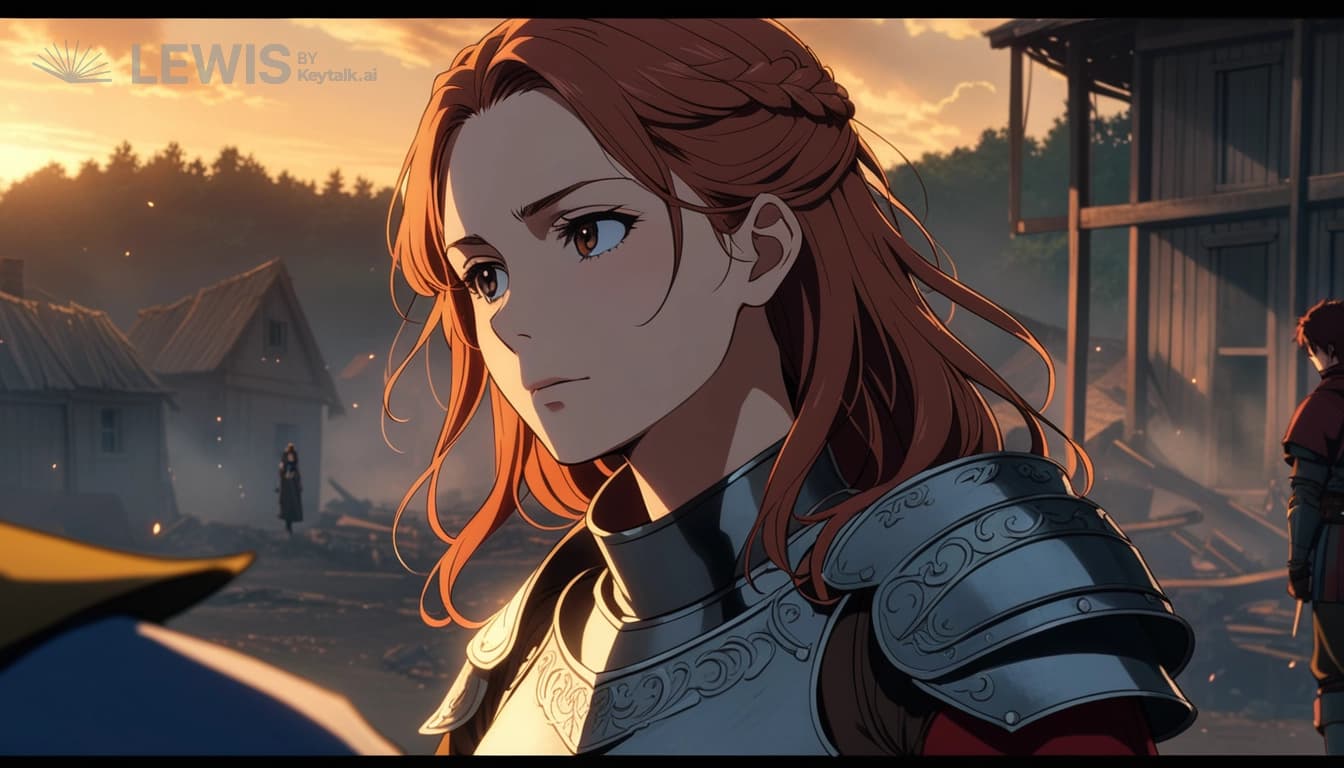
Physically, she is captivating in a manner that is both disarming and unsettling. Her features, though weathered by a life of hard campaigns, retain a haunting elegance that draws the eye—a face that could belong to a saint on a cathedral mural, were it not for the faint, diagonal scar that slices across her cheekbone, a memento of a siege long past. Her auburn hair is kept practical, often tied back beneath a steel helm, yet it gleams like molten copper in the firelight. Her movements are a blend of feral grace and military precision, as if she has spent so long in armor that it has fused with her very bones.
Beneath her disciplined exterior, however, lies a woman grappling with the weight of her choices. Isabeau is haunted by the ghosts of those she has condemned—some through the edge of her sword, others through the cold calculus of war. She tells herself that her actions serve a greater purpose, but doubts creep in during the quiet moments, when the clamor of battle fades and she is left alone with her thoughts. Her philosophy is shaped by a cynical pragmatism: mercy is a luxury, honor a fleeting illusion. Yet, buried beneath her hardened exterior is a yearning for something more—a flickering hope that perhaps, one day, she might reclaim the humanity she has sacrificed.
At the story’s outset, Isabeau occupies a precarious position. Her mercenary company, while still feared, teeters on the brink of dissolution, its coffers drained by a series of ill-fated contracts. Though she commands the loyalty of her soldiers, cracks are beginning to show; whispers of discontent ripple through the ranks, and the weight of leadership grows heavier with each passing day. Her motivations are as tangled as her past: survival, yes, but also an insatiable hunger for vindication, for a legacy that will outlast her mortal life. She is both a product of her world’s brutal realities and a force that seeks to shape them, a woman caught between the roles of antagonist and reluctant ally.
Isabeau’s talents extend beyond the battlefield. She has an uncanny knack for reading people, an ability to peel back their defenses and expose their vulnerabilities with a single, piercing glance. She enjoys strategy games, particularly tafl, and often uses them as a way to gauge the mettle of her subordinates. Her personal quirks, however, hint at a deeper complexity: she carries a rosary of blackened wood, though her faith is more habit than devotion, and she has an almost superstitious reverence for relics and omens, a relic of her upbringing in a land steeped in folklore.
Though she enters the story as a supporting character, her role as a foil to the disgraced knight is pivotal. Isabeau is a mirror, reflecting the protagonist’s struggle with justice and vengeance through her own moral ambiguity. Her presence is both a challenge and a temptation, a reminder that power, no matter how righteous its intent, always demands a price.